

The nRSP-ST networked receiver as a shared resource
The nRSP-ST is ideal as a shared resource for a society, club or any group of people who want to share a good receiving station.
Here are the steps to setting up an nRSP-ST networked receiver:
- Choose a suitable location – someone with a low noise floor and the ability to erect a good antenna for the frequencies of interest. Up to 3 software selectable antennas can be permanently connected.
- Appoint an administrator who will allocate user IDs and passwords for club members. ( If needed, the club members can pay the club towards the cost of buying the receiver). The administrator can also set a mutually acceptable time limit for users.
- Up to 8 members can typically simultaneously share the receiver with the controller choosing which band is selected.
Encouraging After-School Clubs to Embrace Amateur Radio with the nRSP-ST Networked Radio
Amateur radio offers students a unique opportunity to explore electronics, communication, and the science of radio waves in a hands-on, engaging way. For after-school clubs, setting up a networked radio system like the nRSP-ST can transform a typical classroom or function room into a gateway for receiving real radio signals in a noise-free environment, using a high-quality antenna. This setup, combined with building and using a simple low-power CW (Morse code) transmitter for the 40m amateur radio band, can inspire students to dive into the world of ham radio while fostering teamwork, technical skills, and a passion for STEM. In the UK, the Radio Society of Great Britain (RSGB) supports such initiatives by offering 50% funding for youth clubs, making this an accessible and exciting project for schools.
Why Choose the nRSP-ST for Your Club?
Traditional school environments, such as classrooms or multipurpose rooms, often pose challenges for amateur radio activities. Electrical noise from fluorescent lights, computers, and other devices can drown out weak radio signals, and space constraints typically prevent the installation of effective antennas. A portable or makeshift antenna, like a wire or mobile whip, may suffice for transmitting a low-power signal but is often inadequate for receiving all but the strongest signals. This limitation can discourage students who are eager to explore the full potential of ham radio.
The nRSP-ST, a networked software-defined radio (SDR), solves these issues by allowing the receiver to be located at a remote site with an optimal antenna setup, such as the home of a teacher or student with space for a proper antenna, like a dipole or vertical. The nRSP-ST connects to the internet, enabling students to access the receiver from the school clubroom using a computer or tablet. This setup provides a noise-free environment for receiving signals across the HF bands, including the 40m band (7.0–7.2 MHz), which is ideal for local and DX (long-distance) contacts due to its reliable propagation day and night.
With the nRSP-ST, students can listen to CW, SSB (single sideband), and digital modes, gaining exposure to the diverse world of amateur radio. The ability to hear clear, distant signals fosters excitement and curiosity, encouraging students to learn more about radio theory, propagation, and operating techniques. Additionally, the setup and maintenance of the nRSP-ST can be a rotating responsibility among club members, giving technically inclined students a chance to develop skills in networking, SDR configuration, and antenna optimization.
Building a Simple 40m CW Transmitter
To complement the nRSP-ST’s receiving capabilities, students can build a simple low-power CW transmitter for the 40m band, allowing them to make two-way contacts under supervision. A popular and beginner-friendly design is the QRP Pixie CW Transceiver, a minimalist kit that operates on 7.023 MHz (within the 40m CW segment) and outputs about 0.5–1 watt. The Pixie is widely available as a kit for around £5–£10, making it an affordable project for clubs. It consists of a crystal-controlled oscillator, a power amplifier, and a basic receiver, all built with through-hole components that are easy for students to solder.
The Pixie’s simplicity is its strength: it introduces students to circuit design, soldering, and the principles of RF transmission. Under the supervision of a licensed amateur (e.g., a teacher or local radio club member with a Full Licence), students can use the Pixie to transmit CW signals into a basic antenna, such as a half-wave dipole (approximately 20 meters long) or a mobile whip. While these antennas may not be ideal for receiving weak signals, the nRSP-ST’s remote receiver compensates by providing clear reception, enabling students to confirm two-way contacts with stations across the UK or even internationally.
For example, a student transmitting on 7.023 MHz with the Pixie could call CQ and receive a response from a station in Europe, heard clearly through the nRSP-ST. This experience of completing a QSO (contact) is thrilling and reinforces the practical applications of the skills they’re learning. The RSGB’s band plan designates 7.030 MHz as the QRP CW center of activity, making it a great frequency for low-power experiments. Of course a truly homebrew transmitter design could be even more fun if the club leader can organise this and source the components. The design process could even be part of a teaching project!
Setting Up the nRSP-ST as a Shared Resource
The nRSP-ST’s networked nature makes it an ideal shared resource for a club. The receiver can be hosted at a location with a good antenna, such as a teacher’s garden or a student’s home with parental permission. A simple 40m dipole antenna, cut to approximately 10 meters per leg, can be installed at the host site to provide excellent reception. The nRSP-ST connects to the internet, and students access it remotely using SDRconnect software on a club computer, tablet or even a phone.
To encourage participation, the club can rotate responsibilities for maintaining the nRSP-ST, such as checking the antenna, updating software, or monitoring signal quality. This hands-on involvement builds technical confidence and gives students a sense of ownership. For instance, one student might explore propagation projections, while another researches optimal antenna designs. The collaborative nature of the project fosters teamwork and allows students with different interests—programming, electronics, or operating—to contribute.
Clubs can also integrate the nRSP-ST into broader STEM activities. Students could analyze received signals to study propagation patterns, decode digital modes like FT8, or even participate in RSGB contests, such as the 40m CW contests, to test their skills. The ability to access a high-quality receiver from the classroom removes barriers and makes amateur radio accessible to all club members, regardless of their home environment.
RSGB Funding Support for Youth Clubs
In the UK, the RSGB actively supports youth amateur radio initiatives through its Legacy Fund, which provides up to 50% funding for projects that promote radio communication among young people. This funding can cover the cost of the nRSP-ST, antennas, the Pixie CW kits, and other materials, significantly reducing the financial burden on schools. Clubs can apply for this funding by contacting the RSGB and outlining their project, emphasizing how it will engage students in amateur radio. Additionally, the RSGB offers resources like the “Buildathon” toolkit, which includes tools for kit-building workshops, further supporting hands-on learning.
To maximize the chances of securing funding, clubs should highlight the educational benefits of the project, such as developing skills in electronics, teamwork, and communication. Partnering with a local RSGB-affiliated club can also provide access to experienced amateurs who can assist with setup, licensing, and mentoring. The RSGB’s Club Finder tool (available at rsgb.org) can help locate nearby clubs.
Getting Started
To launch an amateur radio project with the nRSP-ST and a 40m CW transmitter, follow these steps:
- Form a Club and Identify a Licensed Supervisor: Ensure at least one adult (e.g., a teacher or local amateur) holds a Full Licence to supervise transmissions. Foundation or Intermediate licensees can participate as operators under supervision.
- In the UK, Apply for RSGB Funding: Contact the RSGB (g0fuw@rsgb.org.uk) to apply for Legacy Fund support, detailing the nRSP-ST setup and CW transmitter project. You might also get advice by contacting RSGB Youth Chair Chris Aitken, MM0WIC via youthchampion.school@rsgb.org.uk
- Set Up the nRSP-ST: Choose a host location with space for a 40m dipole or vertical antenna. Install the nRSP-ST, connect it to the internet, and test remote access from the school.
- Build the CW Transmitter: Either using a Pixie kit, or a homebrew design. Consdider organising a soldering workshop, (in the UK using the RSGB Buildathon toolkit). Test the transmitters with a dummy load before connecting to an antenna.
- Start Operating: Under supervision, have students transmit CW on 7.030 MHz using the Pixie and receive responses via the nRSP-ST. Log contacts and celebrate successful QSOs!
Expand Activities: Encourage students to explore other modes (e.g., SSB, FT8) on the nRSP-ST, participate in contests, or pursue their own amateur radio licenses.
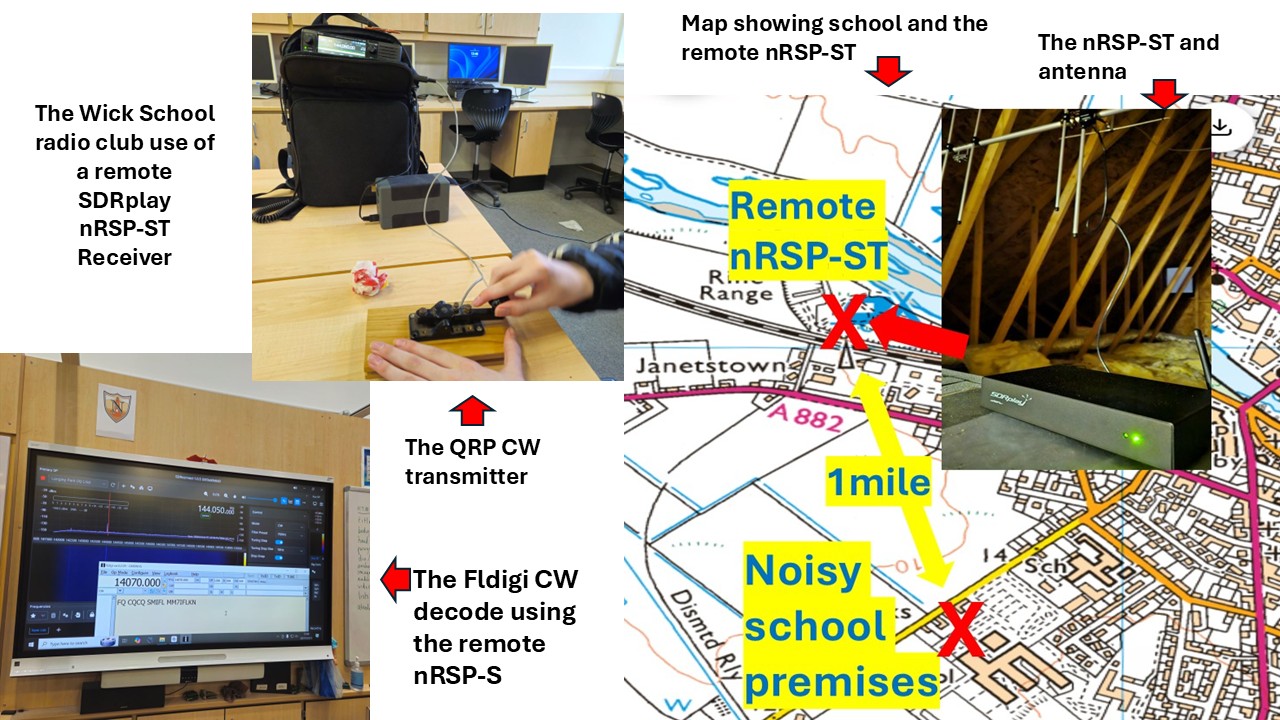
Wick high School example
Chris Aitken who is also RSGB Youth Chairperson, shared this innovative example of how the nRSP-ST is bringing alive radio teaching in his school:
“Wick High School radio club – GM0WHS – has been learning recently about CW and digital modes in school. As an experiment, Jacob MM7IFL, Hannah MM7SAQ, Aden MM3DRB and Emily MM7HPU wanted to set up a reception experiment in class to see if their QRP signal on 2m could be decoded from Mr Aitken’s house where an nRSP-ST was located. Using only a 2m/70cm whip, the students set up their antenna and rig in Mr Aitken’s classroom. To make the experiment a little more challenging, he had the students use the remote SDR feature in SDRconnect on the pupils’ machine to connect remotely to the nRSP-ST and ported the audio to FLDigi to have it decoded and displayed on the big screen.
The students first tried CW mode, both with the auto keyer on the IC-705 and also with a straight key. The students were absolutely over the moon when they could see their signal on the waterfall and then see it decoded on Fldigi.
Next up was RTTY. Just as before, an excellent decode.
The pupils really couldn’t have done an experiment like this on such low power with compromised antennas without the use of the nRSP-ST. It has allowed us a lot more flexibility on trying out low power experiments with the pupils and we look forward to using it a lot more once we have an HF station set up.”
Conclusion
The nRSP-ST networked radio, paired with a simple 40m CW transmitter like the Pixie, offers after-school clubs a powerful way to introduce students to amateur radio. By providing access to a high-quality, noise-free receiver and hands-on building experiences, this setup overcomes the limitations of classroom environments and inspires a lifelong interest in radio communication. With the RSGB’s 50% funding support, UK youth clubs can make this project a reality, fostering the next generation of radio amateurs. Get started today by contacting your local RSGB club or visiting rsgb.org for resources and funding details. Let’s get students on the air and spark their curiosity in the world of ham radio!
For full details of the nRSP-ST – go to https://www.sdrplay.com/nrspst/