Posts by Jon Hudson:
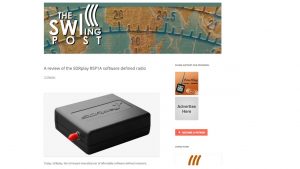
“The RSP1A is the sporty-but-affordable compact car of the SDR world”
Many thanks to the SWLing.com post for this great review of the RSP1A. The author, Thomas summarises with these words:
“Think of it this way: The RSP1A is the sporty-but-affordable compact car of the SDR world. It delivers performance well above its comparatively modest price and is fun to operate. In terms of DX, it gets you from point A to point B very comfortably––and quite affordably!
With just $99, there’s no reason you can’t join the world of SDR––the RSP1A is a very accessible, very intuitive SDR start your exploration of the radio spectrum.”
SDRplay RSP1A software availability update
Here’s an update as to where we are with the software necessary for the new RSP1A.
In addition to the Windows-based SDRuno, SDR-Console V3 preview and HDSDR capabilities already available on day 1, here’s an update on additional software for the RSP1A:
We are happy to report that all the normally supported platforms now have RSP1A-compatible APIs released (i.e. Windows, Linux, Mac, Android, Raspberry Pi and ARM64 )
We’ve asked Josh Blum to pull our SoapySDRPlay changes into his main repository. For now, people can build it from here: https://github.com/SDRplay/SoapySDRPlay
We’ve also rebuilt the Mac version of CubicSDR and that is also loaded onto the website
Over the next couple of days, we will release the following updates for the RSP1A:
ADS-B (dump1090) builds (Windows, Linux, Raspberry Pi)
Raspberry Pi Image (v1.1)
Best regards, Jon SDRplay Marketing Director
PS: Our software can be downloaded from www.sdrplay.com/downloads
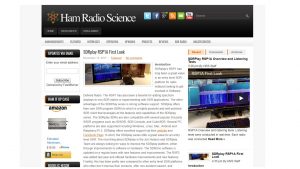
Ham Radio Science publish their “First Look Review” and Video Demo of the RSP1A
Ham Radio Science published their review of the new RSP1A – click on the picture below to get the link their review which includes a YouTube Video Demo and Review
The author writes: “SDRPlay does a great job of listening to it’s user community and it shows in their products. The RSP1A is a great example of that. The more powerful ADC, Broadcast Band Filtering, TXCO, and Bias-T support has the RSP1A knocking on the door of far more expensive SDR receivers. If you are looking for a very inexpensive general coverage SDR receiver with excellent performance, look no further than the SDRPlay RSP1A!”
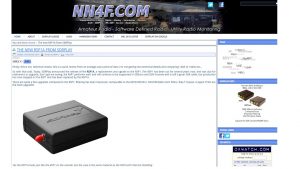
NN4F makes a quick review of the RSP1A “from an average user’s point of view”
Paul, NN4F posted this review of how he finds the RSP1A:
Paul writes: “Overall, I’m very pleased with the RSP1A, I know there will be more in depth technical reviews, but as a regular ham radio user, would I buy the RSP1A, at $99 – Yes with no hesitation; I’ve been running the RSP1A and RSP2Pro in tandem here at the NN4F station, and find that they compliment each other very well”
RTL-SDR.com review of the new RSP1A
Carl Laufer, author of RTL-SDR.com has published a comprehensive review of the RSP1A and summarises the improvements he sees in the new SDR:
Announcing the new RSP1A wideband full featured 14-bit SDR
SDRplay Limited has today announced the launch of a new Software Defined Radio product – the RSP1A.
Check out this special announcement video: https://youtu.be/l_PL–ZQ7hE
The SDR-play RSP1A is a major upgrade to the popular RSP1 and is a powerful wideband full featured 14-bit SDR which covers the RF spectrum from 1 kHz to 2GHz.
Due to its exceptional combination of performance and price, the RSP1 has proved to be a very popular choice as an “entry level” SDR receiver. Since launching the RSP1, we have learned a great deal about what people are looking for in SDR receivers, and where possible, we have incorporated these improvements and new features into the RSP1A.
The RSP1A therefore delivers a significant number of additional features which result in benefits to amateur radio enthusiasts as well as significant benefits for the scientific, educational and industrial SDR community.
Here are the main additional features of the RSP1A compared to the original RSP1:
- ADC resolution increased to 14-bit native for sample rates below 6MHz, increasing to 16 bits with decimation.
- Enhanced RF pre-selection (greater filter selectivity plus 4 additional sub-bands compared to the original RSP1) for reduced levels of spurious responses
- Improved LNA architecture with variable gain. The RSP1 had just a single gain step.
- Improved intermodulation performance
- Performance extended to cover 1kHz to 2GHz with a single antenna port.
- Bias-T facility
- Improved frequency stability incorporating a 0.5ppm TCXO (software trimmable to 0.01ppm)
- Selectable broadcast AM/FM/DAB notch filters
- RF shielding within the robust plastic casing
When used together SDRplay’s own SDRuno software, the RSP1A becomes a high performance SDR platform. The benefits of using the RSP1A with SDRuno include:
- Highly integrated native support for the RSP1A
- Calibrated RF Power Meter with more than 100dB of usable range
- Calibrated S-Meter including support for IARU S-Meter Standard
- The ability to save power (dBm) and SNR (dB) measurements over time, to a CSV file for future analysis
- The IQ output wav files can be accessed for 3rd party applications
SDRplay has also worked with developers of the popular HDSDR, SDR-Console and Cubic SDR software packages to ensure compatibility. As with the RSP1, SDRplay provides multiplatform driver and API support which includes Windows, Linux, Mac, Android and Raspberry Pi 3. There is even a downloadable SD card image available for Raspberry Pi3 which includes Cubic SDR.
The RSP1A is expected to retail at approximately £76 (excluding taxes) or $100 (excluding taxes)
————end of official press release————-
We also sell direct from this website – go to http://www.sdrplay.com/purchase/ and enter your country to confirm taxes and shipping costs to your location – the transaction will not go ahead until after these steps.
I would just like to add a word of thanks to all of our external beta testing group, but in particular, Paul Jones, Preben Lohse Rasmussen, Carl Laufer, Mile Kokotov and Thomas Witherspoon, whose real-world testing and impartial feedback during the development process of the RSP1A was essential in helping us make great improvements to the product.
SDRuno version 1.21 has now been released
SDRuno release 1.21 has now been released. This release of SDRuno contains the following amendments and bug fixes:
1. Restored VFO button for centring of the VFO on the SP1 display
2. Changed the default step size for USB and LSB to 500 Hz
3. Ham band framing buttons can now toggle on or off
4. Recalling stations from the memory panel automatically unlocks the LO if necessary
5. Bug fixes associated with the redrawing the SP1 display
6. Bug fix affecting the storing of calibration values for the RSP2
7. Bug fix affecting CW Zap and CW AFC if the SP2 display FFT is not a 2^n size
8. Changes to the default settings of the SP1 waterfall display
a. Waterfall averaging (WF Ave) now set to ‘off’ by default
b. Tweaks to the default waterfall gain and contrast settings
9. Fixed missing Main Window Instance value
10. Fixed Windows XP support
11. Auto calibration system now selects DAB sub mode if not selected
12. Memory Panel now responds to Ctrl+W
For the changes in the default settings to take place, it WILL be necessary to reset your registry settings, but please note that in doing this, you WILL lose any stored workspaces. We understand that losing saved workspaces when you reset the SDRuno registry settings is frustrating for people and this is something that we will be addressing in a future release.
In terms of future releases, we have a very long list of requests for new features for SDRuno. Some are fairly straightforward to implement and some are very complex and difficult. We have never before published a list of target features for future releases, but we have decided to do so on this occasion. This is intended to give people an insight into what we are aiming for and is NOT a guarantee that any given feature will be implemented. Please be aware that this list is always subject to change at any time.
If we find that we get a chorus of complaints from people disappointed that their desired feature-set is not scheduled for the current or the next release, then we will not make this information available in the future. We have to make priority calls and whilst we aim to implement everything that people want, we cannot do it all at once. I am afraid we are not in a position to indicate when any of these releases will become available.
Feature-sets for future releases:
1.22 Intermediate update
• Customisable frequency step sizes for each mode
• Option to reset SDRuno registry without deleting saved workspaces
• Scheduled recording
1.23 Intermediate update
• Recording of selected signal only (either I/Q or audio) to WAV file format
• Selected signal piped to VAC in I/Q format
• Addition of DDE interface
1.3 Major update
• Frequency scanning
• Remote Client for network based streaming I/Q server applications
1.4 Major update
• Addition of new API for third party plugins
• Separation of VFO and LO frequency control

Download link: http://www.sdrplay.com/downloads
Accurate RF Power Level Logging for wireless IoT developers – a video guide
The ability to make a log of absolute RF power levels centered at a given frequency, and of selectable bandwidth, over specified time intervals is a very powerful capability. Even more so, in portable or mobile situations such as field strength monitoring of both wanted and unwanted signals where an accurate, yet simple and low cost solution is desirable. SDRuno makes it easy to record power and SNR readings as a .CSV file, as is described in this new video guide:
See what these folks are saying about the RSP2 and RSP2pro
Over on the eHam review website (see the link below) we’ve had some very nice comments posted in the last few days from new users of the RSP2pro and RSP2:
KW8L Oct 31, 2017 09:12
AMAZING! Time owned: 0 to 3 months
The RSP2 Pro in one word is, AMAZING! I have had this in my “shack” for a about two months and it does what the manufacturer, SPRplay, says.
Nice to have multiple antenna ports available making it readily adaptable to many different situations and configurations. Small in size, slightly larger than a standard deck of playing cards, all the while being able to “hear” from 1 kHz to 2 GHz. Don’t let the packaging and small size fool you. Quality thru and thru.
I use mine with the included SDRuno software, this allows use as a spectrum scope, panadapter, and very wide band receiver. Lots of features, and some what of a steep learning curve, but worth the time to read, and then re-read the manual again.
Should you find yourself in a situation where issues occur, and answers seem not to be readily available, write them a note. They have successfully answered all of my questions. The user groups are a tremendous asset.
All in all, I would give this product a solid 10 out of 10.
Jack – KW8L
M0MSD Rating: 5/5 Oct 31, 2017 07:55
Excellent Time owned: 6 to 12 months
I can’t praise both the hardware and the support staff highly enough. I just wish all other companies involved with amateur radio would go the extra mile like the SDRPLAY support staff do. I now have two RSP2 Pro units, one for my FTdx5000 and one for my FTDX 300. Both units do exactly what it says on the box. I wanted to do something not usually available with one of the units, the support staff sent me the necessary parts focus. Do you know another company that would do that? If so please let me know and I’ll start using their equipment too.
All I can say is, if you want an SDR or panadaptor then get an SDRPLAY, you won’t be disappointed and their software is as good if not better than any other free software you’ll find.
Please note that I’m only an end user of the equipment and have no other connection with the company.
AE5J Rating: 5/5 Oct 26, 2017 10:36
Amazing! Time owned: 0 to 3 months
Not many products are as impressive as this little unassuming box. I always wanted to dabble with SDR, but could not justify the expense. I got the SDRPlay RSP2 on sale from HRO because the price was almost too good to be true.
Well the RSP2 is better than I expected – by a large margin. I’ve been having a great deal of fun prowling around places I only briefly visited many years ago. The receive is, IMHO, every bit as good as some of the more expensive ham transceivers.
The software from SDRuno works very well, albeit there is a learning curve, but it is worth the investment of time. I’ve also used SDR Console from Simon Brown, the guy who brought us Ham Radio Deluxe. Simon’s software is a bit more aimed at the experienced Ham, but SDRuno offers many of the same features. The answer? Install both and enjoy.
I can’t add much to what has been said already. Be sure and protect the front end on the RSP2. I just connect my main station antenna to the RSP2 OR the ham transceivers. Works amazingly well.
——
If you’re thinking of buying an SDR, you can compare reviews of other radios and SDRs on the eHam website: http://www.eham.net/reviews/products/8