SDRplay highly commended by the popular “OfficialSWLchannel”
In this new video by Gilles from the popular Canadian-based OfficialSWLchannel, SDRplay comes out tops with all 3 RSP receivers featuring in his “top 10”:
Dr. Chuck Higgins recently spoke at the Society of Amateur Radio Astronomers Eastern Conference about the new affordable way in which amateurs can make accurate measurements of Jupiter’s radiation. The RSP1A allows them to monitor sufficient spectrum with the accuracy they need. Check out the video below to find out more:
(The video gives an overview of Radio JOVE 2.0 and includes a short demonstration of the new radio spectrograph using the SDRplay RSP1A receiver with a dipole antenna and the associated Radio-Sky Spectrograph (RSS) software)
JOVE is a US-based public outreach, education, and citizen science project using radio astronomy and a hands-on radio telescope for science inquiry and education. Radio JOVE 2.0 is a new direction using radio spectrographs to provide a path for radio enthusiasts to grow into citizen scientists capable of operating their own radio observatory and providing science-quality data to an archive. Radio JOVE 2.0 uses more capable software defined radios (SDRs) and spectrograph recording software as a low-cost ($350) radio spectrograph that can address more science questions related to heliophysics, planetary and space weather science, and radio wave propagation. Our goals are: (1) Increase participant access and expand an existing radio spectrograph network, (2) Test and develop radio spectrograph hardware and software, (3) Upgrade the science capability of the data archive, and (4) Develop training modules to help people become citizen scientists. We will overview Radio JOVE 2.0 and give a short demonstration of the new radio spectrograph using the SDRplay RSP1A receiver with a dipole antenna and the associated Radio-Sky Spectrograph (RSS) software.
For more information about the project, visit: radiojove.gsfc.nasa.gov
For more about SARA, visit: https://www.radio-astronomy.org/
In this new video, John Fallows, VE2EY describes how diversity reception works, & talks about how well the RSPduo performs for both signal enhancement and noise reduction over such a wide spectrum of frequencies:
The RSPduo is a true dual channel receiver which when used with SDRuno gives diversity reception. It can also be used for real time antenna comparisons for example on HF when conditions are constantly changing. It’s also great for monitoring two widely spaced bands of frequencies (say 80m and 2m amateur bands, or ATC and ADSB) as demonstrated in this video:

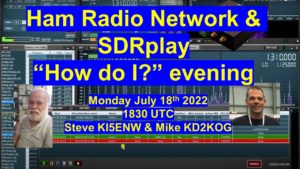
Ham Radio Network are hosting “An Evening with Mike Ladd (KD2KOG) and Steve Brightman (KI5ENW). The theme of the evening will be “How do I…?” and be targeted to SDRPlay device owners that need help, support and guidance with their RSP device or SDRuno.
Join Zoom Meeting
https://us06web.zoom.us/j/5249312563
Meeting ID: 524 931 2563
The room opens at 1915 hrs BST/ 1815 hrs UTC for a 1930 hrs BST/1830 hrs UTC Start
Jan van Katwijk has released an FT8 plugin for SDRuno. In this video for Hamguides, Mike demonstrates how to use it: https://youtu.be/vxFshmAX494
Direct GitHub link to Jan’s FT8 documentation and plugin file: https://github.com/JvanKatwijk/unoPlugins-jan/tree/master/SDRunoPlugin_ft8
FT8 plugin documentation: https://github.com/JvanKatwijk/unoPlugins-jan/blob/master/SDRunoPlugin_ft8/ft8.pdf
Check out the rest of Jan’s plugins by going to: https://github.com/JvanKatwijk/unoPlugins-jan
Visit the SDRplay SDRuno plugins page on: https://www.sdrplay.com/plugins/
One of the much loved features of SDRuno is its memory banks which can store interesting frequency and settings both for easy access or scanning purposes. They can be populated manually, or as ready-made imported files or generated automatically using SDRuno’s built in scanning feature. As well as storing the frequency information and demodulation mode, they can also automatically select which antenna port should be used (e.g. when using an RSPdx, RSP2, RSP2pro or RSPduo which have multiple antenna ports)
Adding and manipulating memory entries can take a bit of of learning and so Mike KD2KOG has put together this new “Ham Guides” video to run through how all this works, including some neat tips on editing existing files for your exact set-up – he has also updated links to his extensive ready-made files and shows how to access them: https://youtu.be/e8nX_m2mkSI
In the video, Mike answers questions like:
Where can I download the SDRuno memory bank files?
How do I install the memory bank files?
How do I edit the input used in these SDRuno memory bank files?
Full instructions on the memory panel can be found in the SDRuno manual (on page 68 of the current version): https://www.sdrplay.com/docs/SDRplay_SDRuno_User_Manual.pdf

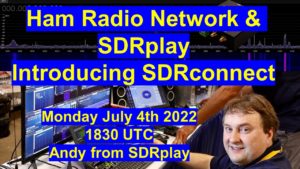
Within the evening, Andy will be discussing and answering questions about SDRConnect V1.0 – the highly anticipated cross-platform interface with remote server capability due out before the end of 2022. It will also be an opportunity to ask questions about SDRplay software in general.
At Ham Radio in Friedrichshafen, Germany SDRplay demonstrated the core underlying technology behind what we’re calling “SDRconnect” which we first showed at Hamvention in Dayton, Ohio in May 2022. Then we showed it working on a Mac M1. At Friedrichshafen, we showed it running on a Raspberry Pi 4.
“SDRconnect” will be the new name for the multiplatform version of SDRuno (up till now we called it SDRuno V2)
In the demo, we showed the completely rewritten Core DSP engine for Spectrum and Waterfall displays – with the prototype software running on a Raspberry Pi. We are also showing the networking capability by remotely accessing an RSP based in the UK.
This is still an early stage demo, and the software team have a lot to do to complete the graphical user interface.
Work is underway on the new graphical user interface which:
SDRplay plans to release the first version of SDRconnect before the end of 2022. It will work with all the current products (RSP1A, RSPdx and RSPduo)
SDRplay is planning that SDRconnect will also support the older obsolete RSP2 and RSP2pro products, although the original RSP1 (phased out in 2017) cannot be supported due to hardware limitations.
(SDRuno V1.42 will continue to be available for RSP1 users).
The new graphical user interface will bring a lot of advantages based on what users have been asking for – like more consistency in the way panels and menus are organised making it more intuitive and easy to use, and the ability to lock panels together.
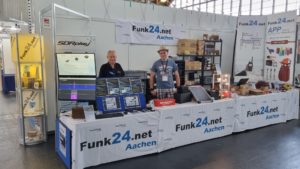
Visitors to Ham Radio can meet with SDRplay and see this demo on the Funk24 stand immediately ahead to the right as you enter the main exhibition area.

Above: Jon G4ABQ with Matthaus DL5FMK on the Funk24 stand
Here’s a video summary of the demo: https://youtu.be/wvZiqLB7xZY
SDRplay resellers on other stands were also showing SDRuno demos and are available to chat in German and French about SDRplay products
In particular, Bonito are at A1-630, Funktechnik Dathe A1-840 and Passion Radio A1-410.

Above: Jon G4ABQ with Thierry F4EGG and Claude F0ELA on the Passion Radio stand

SDRplay will be at Ham Radio, Friedrichshafen – June 24-26. Come and see our SDRconnect demo on the Funk24 booth A1-240 and other displays/demos at Bonito A1-630, Funktechnik Dathe A1-840 and Passion Radio A1-410. We look forward to meeting customers old and new.
The SDRconnect demo is similar to the one we did at Hamvention, Dayton, Ohio but this time is running on a different platform.
More about the Dayton SDRconnect demo here: https://www.sdrplay.com/sdrplay-shows-progress-towards-multiplatform-software-at-dayton-hamvention/
At Hamvention in Dayton, Ohio, SDRplay demonstrated the core underlying technology behind “SDRconnect”
“SDRconnect” will be the new name for the multiplatform version of SDRuno (up till now we called it SDRuno V2)
In this interview by Julian Frost from Ham Radio Outlet, Steve KI5ENW gives an update on our progress in rewriting SDRuno to support multiple hardware platforms:
At Dayton, SDRplay demonstrated the completely rewritten Core DSP engine for Spectrum and Waterfall displays – with the prototype software running on a Mac M1 computer. We are also showing the networking capability by remotely accessing an RSP based in the UK.
This is still an early stage demo, and the software team have a lot to do to complete the graphical user interface.
Work is underway on the new graphical user interface which:
SDRplay plans to release the first version of SDRconnect before the end of 2022.
SDRplay is planning that SDRconnect will fully support the older obsolete RSP2 and RSP2pro products, although the original RSP1 (phased out in 2017) cannot be supported by SDRconnect.
(SDRuno V1.42 will continue to be available for RSP1 users).
The new graphical user interface will bring a lot of advantages based on what users have been asking for – like more consistency in the way panels and menus are organised making it more intuitive and easy to use, and the ability to lock panels together.
This is the video of what we demonstrated: